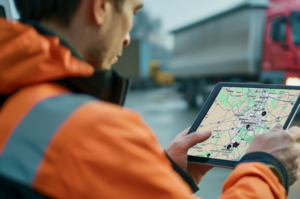
It is mid-afternoon and a key customer is on the phone. They want to know where their delivery is. It left your depot hours ago and they have heard nothing since.
Your dispatchers know the answer. Van three is running forty minutes late after a difficult stop in the morning. But that information lives in a tracking screen only your team can see. Nobody has sent an update. Nobody has flagged the delay. From the customer’s perspective, the delivery has simply disappeared.
By the time the goods arrive, the damage is already done. Not to the freight – to the relationship. The customer did not lose a delivery. They lost confidence. That is the cost of keeping customers in the dark.
This is one of the most common and most avoidable problems in logistics operations today. Automated delivery updates solve it directly – not by improving the delivery itself, but by keeping every customer informed at every stage, without your team having to lift a finger. At RoadFeed, it is one of the core reasons operations tell us communication stopped feeling like a burden.
Why customer communication breaks down in logistics
The challenge is not that logistics teams do not care about communication. Most do. The challenge is that keeping customers informed manually is genuinely difficult to scale.
In a small operation, a dispatcher can make a quick call when a driver is running late. But when you are managing twenty vehicles, three subcontractors, and a hundred deliveries a day, proactive communication becomes the first thing that falls away under pressure.
The result is a familiar pattern:
- Customers call in for updates, creating work for your team at the busiest moments of the day
- Drivers arrive late without warning, and recipients are not at the door or the loading bay is occupied
- Failed deliveries go unnoticed until the customer calls to report they never received their goods
- Disputes arise because there is no clear record of what was communicated, and when
Each of these problems has a downstream cost: redelivery runs, extended customer service time, damaged account relationships, and in some cases, lost business. The issue is not a driver problem or a planning problem. It is a visibility problem – and it compounds every hour your customers are left without an update.
What automated delivery updates actually do
Automated delivery updates replace manual communication with system-triggered notifications that go out to customers at defined points in the delivery journey – without any action required from your team. A customer receives a notification when their delivery is dispatched, when a driver is en route, when an ETA is calculated or updated, and when the delivery is completed. If something changes – a delay, a failed attempt, a reschedule – the customer is informed automatically, with information drawn directly from your live tracking data.
What good automated updates include
- Dispatch confirmation – the customer knows their delivery has left the depot
- Live ETA – calculated from GPS position and route data, updated in real time
- Delay notification – triggered automatically if the driver falls behind schedule
- ETA update – customers receive revised arrival times as the driver progresses through the route
- Exception notification – if a delivery attempt fails or an issue is flagged on the road, the relevant parties are notified immediately
- Delivery confirmation – sent the moment the ePOD is captured, with a timestamp and reference
The operational impact on your team
Automated delivery updates are often framed as a customer-facing feature, but their effect on internal operations is just as significant.
Fewer inbound enquiries
The most immediate impact is a reduction in “where is my delivery?” calls. When customers are receiving accurate, timely updates throughout the day, they have no reason to call. For those who want to check for themselves, RoadFeed’s customer portal gives account holders direct access to POD records, invoices, and reports – so your team is not the first point of contact for information your system already holds.
This compounds as you scale. More deliveries does not have to mean more customer service headcount – not if automated delivery updates are handling the communication from the start.
Fewer failed first-time deliveries
A significant proportion of failed first-time deliveries happen because the recipient was simply not ready. When customers receive an ETA update as the driver progresses through the route, they have time to prepare. Recipients are at the door. Loading bays are cleared. The delivery completes first time.
Every failed delivery is a redelivery cost. Reducing first-attempt failure rates – even marginally – has a direct impact on fuel, driver time, and vehicle utilisation across the week.
Faster dispute resolution
When a customer disputes a delivery, the first question is always: what were they told, and when? If your updates are automated and logged, that question has an immediate answer. You can show exactly what notification was sent, at what time, and with what information.
RoadFeed’s waybill tracking records every stage of the parcel’s journey – from acceptance through to delivery – so you have a full milestone trail to call on if a query arises. Combined with digital proof of delivery – which captures a GPS-stamped, time-stamped signature at the point of delivery – you have a complete, auditable record. Disputes that previously took days to close can be resolved in minutes.
Why manual workarounds are not enough
Some operations try to bridge the communication gap with manual workarounds – a dispatcher sending a message when a driver is running late, or a customer service rep calling key accounts with updates. These approaches have a ceiling.
Manual communication depends on people remembering to send updates in the middle of a busy shift. It is inconsistent by nature. Some customers get a call. Others do not. Some messages go out promptly. Others go out after the delivery has already failed. And the customers who do not receive updates are rarely the ones who shrug it off – they are the ones who call, complain, or quietly move their business elsewhere.
Automated delivery updates remove human memory from the process. Every customer gets the same standard of communication, regardless of how busy the control room is.
How RoadFeed handles automated customer notifications
At RoadFeed, customer notifications are built into the platform – not added as a separate module or a bolt-on integration. They work because they draw on the same live data that powers your dispatch management and real-time tracking, which means updates reflect what is actually happening on the road rather than what was planned at the start of the day.
When a driver’s GPS position triggers a new ETA, that updated time goes to the customer. When a delivery is completed and an ePOD is captured, the confirmation goes out immediately. No manual step. No delay.
This matters particularly for operations managing both in-house drivers and subcontractors. Subcontractor visibility is a common blind spot – you dispatch the load, but once it leaves your control, automated delivery updates stop reaching your customers. RoadFeed extends visibility to third-party carriers, so communication stays consistent regardless of who is making the delivery.
One platform, not a patchwork
In many logistics businesses, customer communication sits in a separate system – a standalone notification tool, an email platform, or a manual spreadsheet – disconnected from the operational data that would make it accurate and timely.
RoadFeed takes a different approach. Dispatch, live tracking, driver management, ePOD, and customer notifications all sit in the same platform – built by the team behind Winfreight with over two decades of logistics software experience. When these systems share data in real time, customer communication is not a separate process. It is an output of the operation itself.
Communication is a competitive advantage
There is a clear operational case for automated delivery updates: fewer inbound calls, fewer failed deliveries, faster dispute resolution, lower admin overhead. But the customer experience case is worth making on its own terms too.
According to research from Transport & Logistics Middle East, top-tier customer experience performers in logistics achieve up to a 25% cost reduction and a 5–10% revenue boost driven by returning customers. Delivery visibility sits at the heart of that performance gap. Customers do not just want their goods to arrive. They want to know where their goods are – and they want to know without having to ask.
A business that communicates proactively – that sends an update before the customer thinks to check – signals competence and reliability. It suggests the operation is in control. That impression, built over dozens of deliveries, is what earns long-term account loyalty.
Conversely, a business that stays silent until something goes wrong signals the opposite. Even if delivery success rates are identical, the customer experience is not.
The logistics industry is increasingly aware of this. Sifted’s 2025 consumer survey on delivery experience found that 76% of shoppers said a positive delivery experience influenced their decision to repurchase from a brand. Communication is a core part of that experience – not a nice-to-have that sits alongside it.
Making the shift: what to consider
Moving to automated delivery updates does not require a wholesale change to your operation. The transition is most effective when approached in clear stages.
- Audit your current communication gaps – Map where customer queries are coming from and at what point in the delivery journey they arise. This tells you which notifications will have the greatest immediate impact.
- Connect communication to live data – Updates are only valuable if they are accurate. Any notification system needs to draw on real GPS and dispatch data, not pre-scheduled messages that do not reflect what is happening on the road.
- Set expectations with customers – Let account holders know what updates they will receive and through which channel. Customers who know to expect a notification are more likely to act on it.
- Review the data over time – Track whether inbound call volumes drop, first-attempt delivery rates improve, and dispute frequency decreases. These are the metrics that quantify the return.
RoadFeed’s platform supports this transition without adding complexity for your team. Our built-in support team provides structured onboarding and is available 24/7 across South Africa, Botswana, Mozambique, Namibia, Zimbabwe, and Australia – so your operation is never left to figure it out alone.
Communication is part of the delivery
Logistics is often evaluated on whether goods arrived. It should also be evaluated on how informed the customer felt throughout the process. Those two things are not the same – and the gap between them is where customer relationships are won or lost.
Automated delivery updates close that gap. They turn the information your operation already holds – live location data, ETA calculations, ePOD confirmations – into a consistent, proactive communication stream that builds trust with every single delivery.
The operations that build loyalty in logistics are not always the fastest or the cheapest. They are the ones whose customers never have to wonder what is happening.
RoadFeed makes that standard of communication straightforward to deliver – without adding workload to your team.
If you want to see how automated notifications work within a fully connected platform, book a demo with RoadFeed and we will show you how your operation can run smarter communication from day one.

Read more articles
- All
- Uncategorized

Delivery workflow management: why Q2 is the right time to review your process

The importance of subcontractor management in freight operations

The growing pains of logistics: how to scale without losing control
Why your logistics team needs delivery dispatch software

Why ePOD is the future of freight