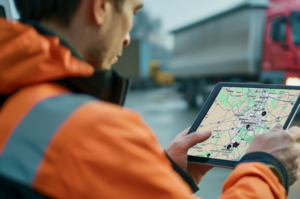
If you run a courier, freight or dispatch operation, you know proof of delivery is more than a piece of paper. It affects how quickly you can invoice, how confidently you can resolve disputes, and how easily you can answer customers when they ask, “What happened to my delivery?”
A familiar scenario plays out on a Monday morning. A key customer is disputing a delivery from Friday. Your driver insists everything was dropped in full, on time. Somewhere there is a paper POD to prove it – but it might be in the cab, on a clipboard, in a depot tray, or on someone’s desk. Finance cannot invoice. Customer service is stuck in the middle. You are trying to reconstruct events from half-legible notes.
That is the cost of paper.
Digital proof of delivery (ePOD) changes that. By capturing signatures, photos, timestamps and location data on a mobile device, ePOD gives you instant, reliable delivery records that flow straight into your freight management system. It cuts paperwork, reduces human error, and speeds up the order-to-cash cycle.
At RoadFeed, we have built an all-in-one dispatch and delivery management system that puts ePOD at the heart of your operation – so you can reduce paper logistics, protect your business, and improve freight management without adding complexity.
From paper chaos to digital clarity
Paper POD worked when volumes were lower and expectations were modest. Today, it creates more problems than it solves.
Typical issues include:
- Lost or damaged documents
- Delayed invoicing while paperwork trickles back
- Handwritten notes that are hard to read or easy to mis-capture
- Limited detail when a customer questions a delivery
In short, paper POD is slow, fragile and difficult to trust at scale.
What is digital proof of delivery – and how does it work?
Digital proof of delivery (ePOD) replaces paper notes with an app on a driver’s phone or tablet. Instead of signing a physical document, the customer signs on glass. The system records:
- Time and GPS location
- Signature and name
- Photos and delivery notes
- Status codes and exceptions
This information is sent straight into your central platform in real time, so operations, finance and customer service are all working from the same, current record.
Industry guides highlight the same core ePOD benefits: less paperwork, fewer errors, faster invoicing and better traceability across the last mile. For a concise overview, see Descartes’ ePOD explainer.
The key ePOD benefits for delivery operations
Digital proof of delivery is more than a paperless form. It changes how your operation runs day-to-day.
Real-time visibility, fewer surprises
With ePOD integrated into your delivery platform, you see job status as it happens – whether you use your own fleet or third-party carriers. You know which drops are complete, which are running late, and where issues are building.
That means you can respond quickly to failed deliveries, update customers proactively, and allocate work based on live information rather than yesterday’s reports.
Faster invoicing and fewer disputes
Because delivery data arrives instantly, finance teams no longer wait days for PODs to return. They can invoice on the same day, improving cash flow and smoothing end-of-week admin spikes.
When there is a query, you have a clear, time-stamped, geo-tagged record and often photographs of the goods at the door. Independent research shows that electronic proof of delivery significantly cuts the time spent resolving disputes and chargebacks because there is less room for error and more objective evidence to work with. Read the statistics on ePOD’s impact,
Stronger compliance and legal protection
In regulated sectors, ePOD helps you demonstrate exactly what was delivered, who accepted it, and when and where it changed hands. Digital records – including electronic signatures that comply with legal frameworks – can carry the same legal weight as handwritten signatures when implemented correctly.
Centralised digital records are also easier to protect. Access can be controlled, and data can be encrypted and backed up, unlike paper files and scattered scans.
Cutting the paper – and the admin that goes with it
If you want to reduce paper logistics, ePOD is a straightforward place to start.
Less manual work, more meaningful work
In a traditional POD process, drivers fill in a form, paperwork returns to the depot, someone scans it, and someone else re-keys it into your TMS, ERP or billing system. Every step takes time and introduces risk.
With ePOD, drivers capture everything once on the device. The data flows directly into RoadFeed, where it is available for dispatch, customer service, finance and reporting with no extra handling.
Saving just a few minutes of admin per delivery, across hundreds of drops a day, quickly frees up hours that can be reinvested into route optimisation, customer communication and performance analysis.
A practical sustainability gain
Digital proof of delivery also helps you reduce waste. Less paper, less printing, less storage and fewer internal courier runs for documents all contribute to a leaner, cleaner way of working – while making day-to-day delivery management simpler.
Why digital proof of delivery matters for high-risk deliveries
Not all freight is equal. For some loads, the quality of your delivery record is as important as the delivery itself.
Pharmaceuticals and temperature-sensitive goods
Pharmaceutical and healthcare deliveries require precise tracking and documentation. With ePOD, drivers can:
- Capture photos of the delivery and related documents, providing instant proof of condition.
- Collect customer signatures on glass, giving you immediate, verifiable proof of delivery.
- Scan batch and lot numbers to ensure full traceability.
Combined with timestamps and GPS data, this provides a robust trail that proves the right products reached the right place, in the right condition.
High-value and sensitive freight
For electronics, luxury items and high-value equipment, digital proof of delivery adds an extra layer of protection. Photos at the doorstep plus a signed ePOD make insurance and loss investigations faster and less contentious.
For dangerous goods or other regulated products, a complete history of handovers – including exceptions or refused deliveries – helps you demonstrate control to regulators and customers, with clear, searchable records instead of stacks of paper.
How ePOD helps improve freight management end-to-end
The real power of digital proof of delivery comes when it is connected to the rest of your operation.
Better decisions through better data
When ePOD feeds into live dashboards and reports, you move from gut feel to data-driven decisions. You can see:
- How long specific customers or locations actually take to service
- Where failed deliveries are clustered
- Which routes are consistently underperforming
That insight helps you improve freight management – adjusting time windows, consolidating drops, balancing work between your own fleet and subcontractors, and tracking the impact of changes over time.
One platform instead of a patchwork
In many businesses, dispatching, tracking, and POD live in separate systems, causing data gaps and repeated work.
RoadFeed takes a different approach. Our all-in-one dispatch and delivery management system, built by the team behind Winfreight, brings everything together in a single platform:
- Smart dispatch and planning
- Real-time GPS tracking
- Subcontractor visibility
- Digital proof of delivery and sign-on-glass
- Dashboards, analytics and reporting
- Built-in support
You do not have to juggle multiple vendors, logins or integrations. When a driver completes an ePOD, that event is visible in operations, in your live dashboards and in the data your finance team uses to invoice – without exports, imports or manual re-keying. One product, one place to manage your entire delivery operation.
Bringing your team along: training for ePOD adoption
Technology only works if people are comfortable using it. Adoption is as important as functionality.
Common concerns from drivers and back-office teams
When you move away from paper, you may hear:
- “I am not good with technology; paper works fine for me.”
- “My route is already tight – I cannot afford extra steps or a steep learning curve.”
- “What happens if the app or network goes down?”
These concerns are normal. Addressing them early helps you build confidence rather than resistance.
A simple plan to move from paper to digital
Switching from paper POD to ePOD doesn’t have to be disruptive. You can ease the transition with three clear steps:
- Map your current POD process – Identify where paperwork slows you down, where documents get lost, and how long it takes to invoice once a delivery is complete.
- Pilot ePOD in a focused area – Choose a set of routes, customers, or vehicles. Track key metrics like admin time, dispute volume, days-to-invoice, and customer feedback.
- Roll out with confidence – Use the results from your pilot to refine workflows, training, and communication before scaling across your fleet and subcontractors.
To help make the shift smoother, RoadFeed offers an intuitive driver app and built-in customer support, backed by over 20 years of logistics experience. We provide 24/7 local assistance in South Africa, Botswana, Mozambique, Namibia, Zimbabwe, and Australia, so your team always has access to the help they need.
Looking ahead: logistics that run on data, not paper
Digital proof of delivery is no longer a nice-to-have. It is becoming the standard for delivery operations that want to run efficiently, protect margins and keep customers informed.
By moving from paper to ePOD, you:
- Cut manual admin and human error
- Strengthen legal and compliance protection
- Free your teams to focus on higher-value work
- Use real-time delivery data to improve freight management end-to-end
The result is a logistics operation that is faster, more transparent and easier to control.
If you’re ready to move beyond paper POD and create a delivery process that aligns with the future of the industry, this is the ideal time to make the transition.

Read more articles
- All
- Uncategorized

Delivery workflow management: why Q2 is the right time to review your process

The importance of subcontractor management in freight operations

The growing pains of logistics: how to scale without losing control

How automated delivery updates keep customers informed

Why your logistics team needs delivery dispatch software