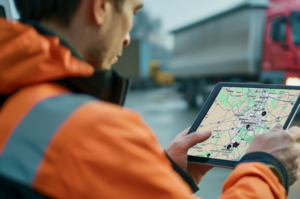
It is just after two o’clock and a dispatcher is waiting for a call back. Three loads went out with subcontractors this morning. One driver checked in at midday. Two have not been in touch since they left the depot.
She calls again. Both go to voicemail. A customer email arrived twenty minutes ago asking for an ETA. She does not have one, and she has no way of finding out without the subcontractors picking up.
This is the moment subcontractor management stops being an operational inconvenience and becomes a commercial risk. The delivery is not yours to complete. But the relationship is entirely yours to lose.
For many freight businesses, subcontracting is not a choice – it is a structural necessity. It is how you manage overflow during busy periods, cover routes outside your usual area, and grow without immediately committing to a larger permanent fleet. Used well, subcontractors are a genuine competitive advantage. But that advantage only holds if you can manage third-party carriers with the same level of control you apply to your own team. Subcontractor management in freight operations has become a core operational discipline precisely because the gap between what a subcontractor does and what your customer experiences is entirely your responsibility.
Why the visibility gap is so costly
When a load leaves your depot with a third-party carrier, most operations experience the same thing: the delivery effectively disappears. You know it was assigned. You know roughly where it is going. Beyond that, you are relying on the subcontractor to call, message, or update a system they may not have been trained to use.
That reliance is fine when volumes are low and the subcontractors are familiar. It becomes a liability when volumes grow, new carriers are added, and the day runs at a pace that leaves no room for chasing updates.
The cost of that visibility gap shows up in predictable places. Customers call in for updates your team cannot provide without making several calls first. Deliveries fail first time because nobody updated the recipient on an ETA. Proof of delivery arrives late, incomplete, or not at all – holding up invoicing for days. And when something goes wrong, you are trying to reconstruct what happened from a chain of WhatsApp messages rather than a clean audit trail.
None of these are catastrophic in isolation. At volume, they compound into a measurable drain on efficiency, cash flow, and customer trust.
What your customer actually sees
Your customers do not distinguish between your internal drivers and your subcontractors. They placed an order with your business. They expect your standard of service, your communication, and your accountability – regardless of who is physically in the truck.
That expectation is not unreasonable. It is simply the reality of how freight relationships work. Your company name is on the job. The customer’s experience of that job determines whether they send you the next one.
This is why subcontractor management in freight operations is not just an internal operations problem. It is a customer experience problem. The businesses that manage it well – that keep customers informed even when a third-party carrier is making the delivery – build a level of confidence that competitors without that capability cannot easily replicate.
The businesses that do not manage it consistently find themselves in a familiar position: apologising for a delivery they did not personally control, with no data to explain what went wrong.
Visibility is the foundation of subcontractor control
The single most important change a logistics business can make to its subcontractor management is bringing third-party carriers into the same operational view as its internal fleet.
When subcontractors are visible in the same system – same live tracking, same status updates, same delivery milestones – the dynamic shifts entirely. Dispatchers are no longer waiting for a call to know whether a delivery is on track. They can see it. They can act on it before it becomes a problem rather than after.
This is what real-time GPS tracking across both own-fleet and third-party carriers actually delivers in practice. Not just the comfort of knowing where your drivers are – but the operational capability to manage exceptions before they escalate, update customers proactively, and maintain the same standard of communication across every delivery, regardless of who is completing it.
When your dispatcher can see that a subcontractor’s driver is running forty minutes behind schedule, they can notify the customer before the customer calls in. That is not a small thing. It is the difference between a managed delay and a broken relationship.
The documentation problem – and why it matters more than you think
Proof of delivery is where subcontractor management most visibly affects your business finances.
With your own drivers, you can enforce a process. Drivers use the system, capture the POD, and the record is there before the vehicle returns to the depot. With subcontractors, that discipline is harder to maintain. Paper documents come back late, or not at all. Photos sit on a driver’s personal phone. Signatures are missing. And until that paperwork is in order, your invoice cannot go out.
For high-volume operations, the cash flow impact of delayed PODs is not trivial. A week’s worth of deliveries sitting in documentation limbo represents real money that the business is owed but cannot yet claim.
Digital proof of delivery solves this at the source. When subcontractors use the same ePOD system as your internal drivers – capturing sign-on-glass, photographs, GPS coordinates, and timestamps at the point of handover – the record is in the system the moment the delivery is complete. Finance can invoice the same day. Customer queries can be answered in seconds. And when a dispute arises, the evidence is already there.
A consistent digital POD process across your entire operation – internal and outsourced – is one of the most straightforward ways to reduce the administrative cost of subcontracting.
You cannot manage what you cannot measure
As your freight operation grows and the number of subcontractors in your network increases, a new problem emerges: you need to know which carriers are performing and which ones are creating risk.
Without data, that question is answered by memory and instinct. A dispatcher remembers that a particular subcontractor was unreliable last month. A transport manager has a general sense that one carrier is better than another on a certain route. These impressions are useful – but they are not a management system.
Live dashboards and real-time reporting change that. When on-time rates, first-attempt delivery success, exception frequency, and POD completion times are tracked across every carrier in the network, managers have the data to make informed decisions. Which subcontractors to use for key accounts. Which routes to keep in-house. Where performance is slipping before a customer notices.
Performance visibility also changes the dynamic with subcontractors themselves. When carriers know that delivery data is tracked, service standards become explicit rather than assumed. That tends to improve accountability across the network.
One system beats a patchwork every time
The most common approach to subcontractor management in freight operations is also the most fragile: dispatch through one system, tracking through another, customer communication via email, PODs on paper, and subcontractor updates over WhatsApp. Each tool was added to solve a specific problem. Together, they create a system where nobody has a complete picture of what is happening.
That fragmentation is manageable at low volumes. It becomes unworkable as the operation scales – and it becomes particularly costly when subcontractors are involved, because third-party carriers do not naturally fit into a workflow that was designed around your internal team.
When dispatch management, live tracking, digital ePOD, customer notifications, and reporting all sit in the same platform, subcontractor management stops being a separate operational effort. It becomes part of the same workflow as everything else. Loads are assigned, delivery progress is monitored, PODs are captured, customers are updated, and performance is measured – all in one place, for every carrier in the network.
That integration is not just a convenience. It is what makes consistent subcontractor management possible at scale.
Managing subcontractors as part of your operation, not separately from it
RoadFeed was built by the team behind Winfreight, with over two decades of experience in logistics software across southern Africa. That background shapes how the platform approaches subcontractor management – not as a bolt-on feature, but as a core operational capability that sits alongside dispatch, tracking, ePOD, and customer notifications in a single connected system.
The operational effect is straightforward. When a load is assigned to a subcontractor through RoadFeed, it does not disappear from your view. You can see its progress in real time, alongside your own fleet. Your customer receives the same automated updates they would receive for an internal delivery. And when the POD is captured, it is in the system immediately – whether the driver is yours or not.
According to Transport Topics, the freight industry’s leading trade publication, third-party logistics providers continue to demonstrate their value precisely in their ability to maintain visibility and accountability across carrier networks during volatile market conditions. For freight businesses relying on subcontractors to grow, that visibility is the difference between subcontracting being a source of capacity and subcontracting being a source of risk.
What a well-managed subcontractor process actually looks like
The goal of subcontractor management in freight operations is not to replicate the control you have over your own fleet. It is to maintain service quality and operational visibility regardless of who is completing the delivery. A well-managed process makes that achievable without adding significant overhead to your team.
In practice, it looks like this: a load is assigned through a central dispatch system – the same system used for internal drivers. The subcontractor’s progress is tracked in real time. The customer receives automated updates as the delivery progresses. Proof of delivery is captured digitally at the point of handover. And delivery performance data is available in a dashboard, ready for review, without anyone having to compile a report.
The subcontractor is completing the delivery. But the operation is still yours. The visibility is still yours. The customer experience is still yours.
That is what the right system makes possible. Not a separate subcontractor management effort running in parallel with everything else – a unified operation where internal and outsourced deliveries are managed to the same standard, through the same tools, with the same level of accountability.
If your freight operation relies on subcontractors and you want to understand what that level of visibility looks like in practice, book a demo with the RoadFeed team, and we will show you how the platform manages third-party carriers alongside your own fleet.

Read more articles
- All
- Uncategorized

Delivery workflow management: why Q2 is the right time to review your process

The growing pains of logistics: how to scale without losing control

How automated delivery updates keep customers informed

Why your logistics team needs delivery dispatch software

Why ePOD is the future of freight