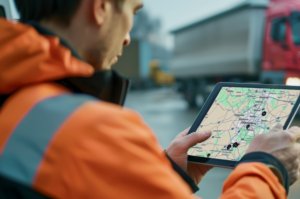
The role of logistics analytics: Using data to improve delivery performance
The delivery day is almost over, and the numbers are not where they should be.
The dispatch team knows the day was difficult, but the exact reasons are harder to pin down. A few routes ran late. One driver had repeated delays. A customer called twice for updates. A subcontractor delivery took longer than expected. Several PODs were only captured after the fact. Everyone knows there were issues, but no one has a clean view of where they started.
By tomorrow morning, the team will move on to the next set of loads. The same routes will run. The same customers will expect updates. The same drivers and subcontractors will be out on the road. Unless the business can see what happened clearly, the same problems may repeat.
That is where logistics analytics becomes important.
In freight and delivery operations, data is not only useful for monthly reporting. It is useful because it helps teams understand daily performance, identify recurring issues and make better decisions while there is still time to act.
For logistics businesses that want to improve delivery performance, reduce delays and control operating costs, real-time reporting is no longer a nice-to-have. It is becoming part of how strong operations are managed.
Why delivery performance is difficult to improve without data
Most logistics teams already have a sense of where the pressure points are. Dispatchers can feel when the day has become too reactive, drivers know when route instructions are unclear, customer service teams notice when delivery updates are missing, and finance can see when late PODs start slowing down the billing process. Managers may also recognise when overall performance is slipping, but without clear data, those insights often remain scattered across different teams, conversations and systems.
The challenge is that these insights are often scattered across people, systems and conversations.
A dispatcher may remember that a certain route often runs behind schedule, while a transport manager may know that one subcontractor usually needs more follow-up than others. Customer service may also notice that some customers phone more often for delivery updates, and finance may see that certain PODs are consistently delayed. Each team has useful insight, but when those observations sit separately, it becomes difficult to see the full pattern behind recurring delivery performance issues.
All of that knowledge matters. But without clear logistics analytics, it is difficult to turn those observations into measurable improvement.
When decisions are based mainly on memory, instinct or manual feedback, the business can miss patterns. It may treat each delivery issue as an isolated event instead of seeing the wider trend behind it.
The result is familiar: teams work hard to solve the same problems repeatedly, but the underlying causes remain hidden.
What logistics analytics actually shows you
Logistics analytics gives teams a clearer view of how delivery operations are performing.
- It can help answer practical questions such as:
- Are deliveries being completed on time?
- Which routes experience the most delays?
- Where do failed delivery attempts happen most often?
- Which drivers are performing consistently?
- Which subcontractors need closer management?
- How quickly are PODs being captured?
These are not just reporting questions. They are operational control questions.
When the answers are visible, managers can make better decisions. They can adjust routes, review subcontractor performance, support drivers, reduce manual communication, improve customer updates and identify where the workflow needs attention.
Without those answers, improvement becomes difficult to measure. The team may feel busy, but it may not be clear whether performance is actually improving.
Real-time reporting changes the timing of decisions
Traditional reporting often looks backwards.
A report is compiled at the end of the week or month. Management reviews what happened. The team discusses delays, delivery failures, customer complaints or invoicing issues. By then, the work has already moved on.
That kind of reporting still has value, but it is not enough for fast-moving logistics operations.
Real-time reporting gives teams visibility while the day is still active. Instead of waiting for a report to confirm that a route was late, the team can see the delay developing. Instead of discovering later that a POD was not captured, the system can show that the delivery has been completed but proof is still outstanding. Instead of waiting for a customer complaint, the team can identify a delivery exception and communicate proactively.
That timing matters.
The earlier a logistics team can see an issue, the more options it has. A dispatcher can reassign work. A customer can be updated before they call in. A subcontractor can be followed up before the delivery window is missed. A manager can intervene before one issue affects the rest of the day.
This is where real-time reporting in logistics becomes a performance tool, not only a management report.
Delivery delays are easier to reduce when patterns are visible
Every logistics business deals with delays.
Some delays are unavoidable. Traffic, weather, customer availability, route changes and loading issues can all affect delivery performance. But not every delay is random. Many delays follow patterns that become visible once the data is tracked properly.
A certain route may regularly run late because the planned delivery window is unrealistic. A driver may lose time because job details are incomplete. A subcontractor may underperform on specific routes. A depot may release loads later than planned. A customer may frequently be unavailable at the first delivery attempt.
Without analytics, these issues can feel like daily frustrations. With analytics, they become visible patterns that can be addressed.
That is how logistics teams start to improve delivery performance in a practical way. They stop relying only on after-the-fact explanations and start looking at the data behind repeated delays.
The goal is not to remove every exception. Logistics will always involve movement, pressure and change. The goal is to understand which exceptions are preventable, which ones need better communication and which ones point to a deeper workflow problem.
Customer communication improves when data is live
Customers do not only judge a delivery by whether it arrives. They judge the experience around it.
Was the ETA clear? Were they updated when something changed? Did they have to phone for information? Did the delivery status match what they were told? Was proof of delivery available when needed?
Customer communication often breaks down when the team does not have live delivery data.
If a customer asks for an ETA and the team has to phone the driver, check a separate system or wait for a subcontractor to respond, the communication is already delayed. Even if the answer is eventually provided, the customer has experienced uncertainty.
Live delivery data changes that.
When dispatch, tracking and delivery status information are visible in one place, teams can communicate with more confidence. Automated updates can keep customers informed without adding more manual work to the control room. When an exception happens, the business can respond earlier and more clearly.
This improves customer experience, but it also reduces internal pressure. Fewer manual update requests mean fewer interruptions for dispatch, customer service and drivers.
Analytics helps manage drivers and subcontractors more fairly
Performance management in logistics can become difficult when it is based on incomplete information.
Good logistics analytics helps create a fairer and more accurate performance picture.
When teams can see on-time delivery rates, delivery completion times, exception frequency, POD turnaround and route performance, conversations become more objective. Managers can identify where support is needed, where standards need to be reinforced and where operational planning should be adjusted.
This also helps with subcontractor management.
As third-party carrier networks grow, it becomes important to know which subcontractors are supporting service levels and which ones are creating risk. Without reporting, those decisions are often made from memory or frustration. With data, the business can review performance more consistently.
That does not remove the human side of logistics. It strengthens it. It gives teams better information so that decisions are based on facts, not only assumptions.
POD data connects delivery performance to cash flow
Proof of delivery is one of the clearest examples of how operational data affects business performance.
A completed delivery does not create full value until the proof is captured, accessible and ready for the next step. If POD is delayed, incomplete or difficult to find, the effect moves beyond operations. It can affect invoicing, customer queries, dispute resolution and cash flow.
This is why POD reporting should form part of any logistics analytics view.
Managers should be able to see how quickly PODs are being captured, where delays are happening and whether certain drivers, routes or subcontractors are creating repeat documentation issues. Finance teams benefit when proof is available quickly. Customer service benefits when delivery records are easy to access. Operations benefits when the delivery loop closes cleanly.
ePOD makes this easier because the data is captured at the point of handover. Signatures, timestamps, GPS coordinates and supporting images can become part of the delivery record immediately.
When this information feeds into reporting, the business can see more than whether a delivery was completed. It can see how efficiently the delivery was closed.
Cost reduction starts with operational visibility
Cost control in logistics is not always about cutting resources. Often, it is about reducing waste inside the workflow.
Unnecessary calls. Repeated manual updates. Failed delivery attempts. Delayed PODs. Poor route planning. Underperforming subcontractors. Customer queries that could have been avoided. Time spent compiling reports manually.
These costs may not always appear as a single line item, but they affect the operation every day.
Logistics analytics helps expose where that waste is happening.
This is how real-time reporting supports cost reduction. It helps teams identify the small operational inefficiencies that become expensive at scale.
The purpose of analytics is not to create more dashboards for the sake of it. It is to give decision-makers the information they need to improve the way work moves through the business.
Why live dashboards matter in daily logistics operations
A dashboard is only useful if it helps the team act.
In logistics, a useful dashboard should give operations teams a clear view of what is happening now, what needs attention and where performance is trending over time.
That may include:
- Live delivery status
- Driver and vehicle visibility
- On-time delivery performance
- Route progress
And more…
When this information is visible in one place, teams do not have to rely on scattered updates to understand the day. They can make faster decisions with more confidence.
For managers, live dashboards also make it easier to review performance without waiting for manual reports. They can see whether the operation is improving, where issues are repeating and which areas need further attention.
That visibility supports both daily control and longer-term planning.
How RoadFeed supports logistics analytics and reporting
RoadFeed brings dispatch, live tracking, driver management, digital proof of delivery, customer notifications, subcontractor visibility and reporting into one connected platform.
That connection is important because logistics analytics is only as useful as the data feeding it.
When dispatch happens in one place, tracking in another, POD on paper, customer updates through email and subcontractor communication through separate messages, reporting becomes difficult. The data is scattered before anyone even tries to analyse it.
RoadFeed helps create a clearer operational picture by keeping core delivery activity connected from dispatch to proof.
Dispatch teams can see assigned work and delivery progress. Managers can monitor live delivery status and performance trends. Customer updates can be linked to delivery events. PODs can be captured digitally and made available quickly. Subcontractor activity can be included in the same operational view as internal fleet activity. Reporting helps the business understand what is happening across the workflow.
The benefit is not just more data. It is more usable data.
For logistics teams that want to improve delivery performance, this matters. It means managers can move from “what went wrong?” to “where is it happening, how often, and what can we do about it?”
What to review before improving delivery performance
Before a logistics business can improve performance, it needs to know what it is measuring.
A practical review should look at:
- How often deliveries are completed on time
- Where delays happen most often
- How many customer queries relate to delivery status
- How quickly PODs are captured after delivery
- How often proof is missing, incomplete or delayed
- Which routes create repeated exceptions
- Which drivers or subcontractors need additional support
- How much manual admin is required to keep the workflow moving
- How quickly managers can access accurate reporting
- Whether performance data is available in real time or only after the fact
These questions help teams move beyond general frustration. They show where improvement can actually begin.
Better data creates better logistics decisions
In logistics, performance does not improve simply because teams are busy. It improves when teams can see what is happening, understand why it is happening and act before the same problems repeat.
That is the role of logistics analytics.
It gives dispatchers better visibility. It gives managers better performance insight. It gives customer service teams better delivery information. It gives finance teams better proof availability. It gives leadership a clearer view of where operational efficiency is being gained or lost.
For growing logistics businesses, that clarity becomes increasingly important. More deliveries, more routes, more drivers and more subcontractors create more data. If that data is scattered, it becomes noise. If it is connected and visible, it becomes a tool for better control.
The businesses that improve delivery performance consistently are the ones that do not rely only on instinct. They use real-time reporting to understand the operation as it moves.
If your logistics team wants clearer visibility over delivery performance, RoadFeed can show you how live dashboards, digital POD, real-time tracking and connected reporting work together in one platform.

Read more articles
- All
- Uncategorized

7 reasons all-in-one dispatch management software changes the way freight operations run

Scaling your logistics operations: How to stay efficient as you grow

Delivery workflow management: why Q2 is the right time to review your process

The importance of subcontractor management in freight operations

The growing pains of logistics: how to scale without losing control
How automated delivery updates keep customers informed

Why your logistics team needs delivery dispatch software

Why ePOD is the future of freight